
EPL alumni, fellows and partners contribute to Future of Development Cooperation Coalition consultations
Emerging Public Leaders (EPL) and the Future of Development Cooperation Coalition recently co‑hosted a hybrid consultation on public leadership and state capability, linking Coalition leaders online with EPL young leaders in Monrovia. The session, held alongside EPL’s 2026 Alumni Network Gathering, created a dedicated space for young African public servants to speak directly into global debates on how development cooperation must evolve.
The consultation brought together EPL fellows and alumni working across ministries, agencies and oversight bodies in Ghana, Kenya, Liberia, Malawi and Sierra Leone, many of whom are leading reform efforts from inside government.
The consultation was anchored by opening remarks from Ofovwe Aig‑Imoukhuede, Executive Vice‑Chair of the Aig‑Imoukhuede Foundation. Drawing on her foundation’s work with mid‑career public servants in Nigeria and across Africa, she emphasised that good ideas only matter if institutions can carry them:
“Capable institutions are built by capable leaders, but capable leaders can only achieve lasting impact when the institutions around them create the conditions for their success.”
She also underlined that talent is not the binding constraint:
“Across Africa there is no shortage of talented public servants who enter government with ideas, energy and a genuine commitment to improving people’s lives – but good ideas do not automatically become results.”
For many EPL fellows and alumni in the room, this focus on both leadership and institutional capability captured their own experience inside government.
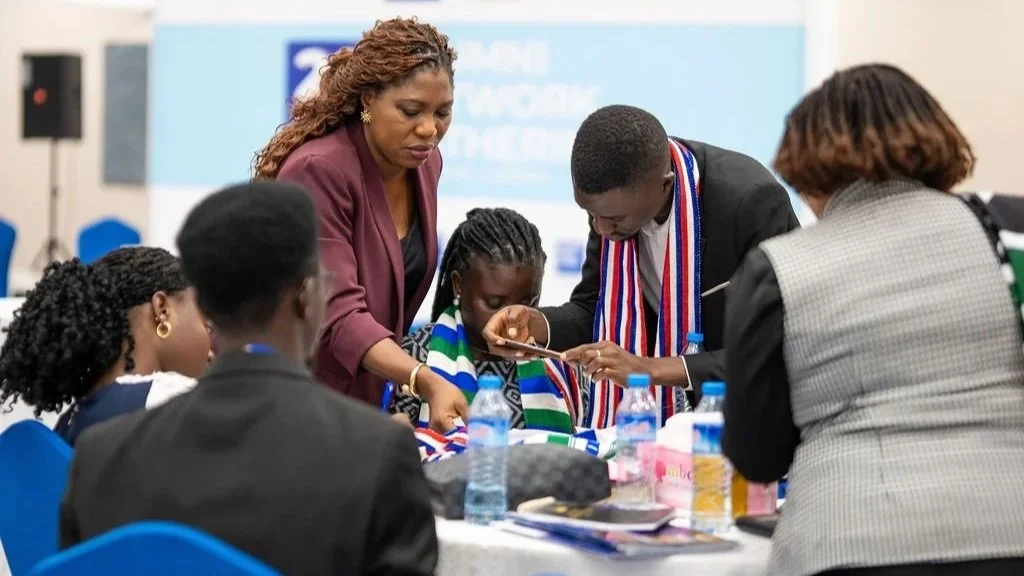
Alumni engage with interactive polling during session on the future of development cooperation.
Joining online, Alexia Latortue, Head of the Coalition Secretariat, set this in a broader frame. She explained the Coalition’s ambition to reimagine development cooperation from the perspective of countries’ own ambitions and capacities, noting that in consultations around the world people talk first about their expectations of government, not of aid.
“We must absolutely start with countries themselves – their own ambitions and aspirations – and then ask what partnerships they want, rather than starting from aid.”
Abigail Kajumba, EPL’s outgoing Executive Director and one of the Coalition’s commissioners, helped connect the Monrovia discussion to the Coalition’s wider listening process and invited participants to be specific about what helps and hinders government delivery.
In Monrovia, facilitation was led by Juliet Amoah, EPL Ghana Country Director, and Emily Stanger Sfeile, EPL Interim Executive Director. As the group navigated the practical realities of a hybrid format, they helped fellows and alumni move from opening remarks into an interactive consultation, using Mentimeter live polling, small‑group conversations and plenary exchanges to draw out participants’ experiences of leading from within public institutions.
Using live polling and discussion, alumni and fellows sent a very clear signal. When asked what most enables governments to deliver results, almost half of respondents chose “institutional capability”, almost twice the next option; not a single participant selected external support or talent shortages as the binding constraint. For a room full of young public leaders, the problem is not people or money – it is the strength of the institutions around them.
In open responses, participants pointed to three recurring themes:
Implementation gaps – good policies fail when institutional culture, coordination, monitoring and evaluation, and political continuity do not match the ambition on paper.
Misaligned partnerships – external actors are most helpful when they align with clear country strategies and work through government systems; they weaken institutions when they bypass them to move faster, often because procurement and other systems are slow.
Capacity building as “activity instead of outcome” – alumni called for support grounded in real needs, linked to concrete institutional outputs and matched with space to apply what is learned, rather than generic, one‑size‑fits‑all workshops.
Together, these messages underline the core thesis of the consultation: invest in leaders, but also in the institutions that enable those leaders to deliver.
This EPL–Coalition consultation is part of a wider process that will continue through 2026, drawing further on EPL’s network of fellows and alumni across Ghana, Kenya, Liberia, Malawi and Sierra Leone.
Together, Emerging Public Leaders, the Future of Development Cooperation Coalition and partners such as the Aig‑Imoukhuede Foundation are working to ensure that the lived experience of public servants inside government systems shapes the future of development cooperation.