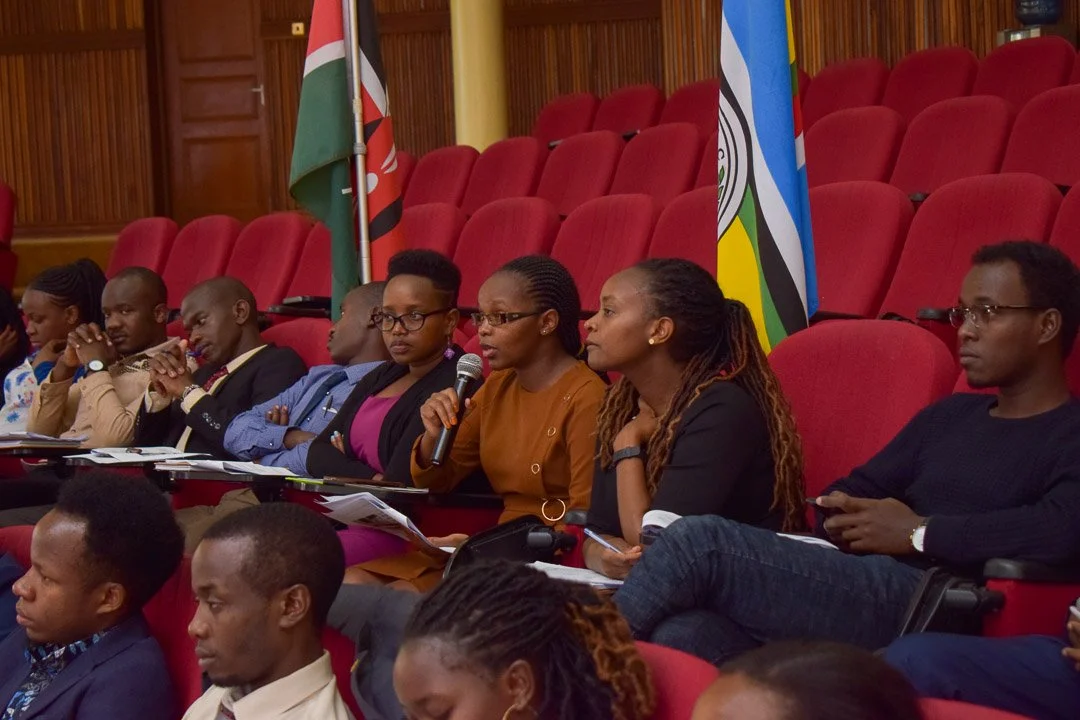
The inaugural cohort of the Public Service Emerging Leadership Fellows attended training at the Kenya School of Government to bolster their leadership and policy development skills. These Fellows are all current civil servants between the ages of 25 and 35 and are the young workforce voting in the 2022 general election.
Nairobi, Kenya - Today, Kenyans over the age of 18 will go to the polls to elect their new political leaders. In addition to deciding who will become the next president, they will also vote for members of the National Assembly and Senate, county governors and members of the county assemblies.
The season of general elections is always a good time to reflect on what the priorities of a government should be for its citizens going forward. With three-quarters of its population below the age of 30, it is only right that the youth agenda is atop the list of priorities for incoming leaders at national and subnational levels in Kenya. A youth agenda typically translates to policies and programs on education, employment, and climate change, but the dialogue that advances the priorities for the youth will be richer in context if it is cognizant of certain numbers.
The first number is 15 percent. This number represents the percentage of the workforce in the Kenyan public sector who are below the age of 40and is starkly disproportionate to the country’s demography, which has an average age of 20. A public sector workforce that is lopsidedly staffed with older people will miss out on the innovation and leadership that young people offer. Many politicians running for office make claims that delivering public services efficiently would be a priority for them, but this would only be possible if their administration can harness new technologies and tools that younger people are more likely to be adept at developing and implementing.
It is noteworthy that the Kenyan constitution was designed to institutionalize youth inclusion in government by allocating two seats in the Senate to young people, but this does not go far enough. Having only 2 young people out of 67 senators is not commensurate with Kenya’s demographic reality. While young people are technically allowed to contest for other seats in the Senate and National Assembly (the minimum age for eligibility for both houses of parliament is 18), there are many systemic barriers that make it difficult for them to run successful campaigns –chief of which is income inequality across generations.
Therefore, for both elective and non-elective positions in the public sector, the new set of Kenyan leaders that will emerge must mainstream youth inclusion into the fabric of public sector governance. They can either enact new programs and policies that enable the recruitment, retention, and election of youth into the public service or consolidate on existing programs such as the Public Service Emerging Leaders Fellowship, which places young Kenyan civil servants on a leadership pathway by providing them with sound training, customized professional development, and mentoring support.
The second number to note is the youth dependency ratio which stands at 77 percent. In other words, for every 100 Kenyans of working age, there are 77 dependents (comprising children below 15 and retired adults over 64). This number is key because it provides policymakers with important insights into the relative economic burden of the Kenyan workforce and the implications for tax payments. For example, if newly elected leaders decide to promulgate social welfare programs for the elderly, the burden of paying for it (through tax burdens ) will fall on the pool of young people who are in the workforce.
It also gives insight into the feasibility of harnessing a demographic dividend: A preponderance of young people in an economy facilitates more value creation and addition with little expenses on social services. Asian countries like Malaysia, South Korea and Singapore which have a recent history of benefiting from a demographic dividend had a dependency ratio lower than 50 percent. While the dependency ratio has been falling in Kenya over the last two decades, it is likely to rise again as the current mass of young people start retiring and fertility rates remain high. In other words, there is a wide but time-bound window of opportunity for Kenya to make its young population translate into high-income status for its citizens.
A different number that has bearings on the ability to make this translation of youthfulness to economic prosperity happen is the human capital index. It is a measure of the amount of human capital that a child born in Kenya today can expect to acquire by age 18, given the risks of poor health and poor education that prevail in the country. In 2021, the human capital index in Kenya was 0.5, meaning that the future earning potential of Kenyan children born last year is only half of what it could have been if they had comprehensive education and full health.
Political leaders that will emerge from the general elections should recognize how unrealized human capital potential contributes to a net loss for Kenya. Beyond recognizing it, they should make these two sectors immediate priorities in their respective roles as executive leaders and lawmakers. Specifically, public expenditure must match international benchmarks such as the Abuja Declaration on health and the Paris Declaration on education that commit countries to allocate at least 15 percent of their national budget to health and education respectively. Kenya is currently underperforming with respect to spending on the health sector. For the politicians running for office in this general election, campaign promises to invest in these crucial sectors for human capital development will be litmus-tested by the budgetary allocations towards them.
The general election this August will ultimately be decided by numbers, but a different set of numbers will impinge on the policy and decision making of the eventual office holders. The percentage of youth in the public sector, the dependency ratio, and the human capital index are three such numbers that will come in handy for optimal decision making that will brighten Kenya’s rich future.
Notes:
About Emerging Public Leaders
Emerging Public Leaders is a public service leadership organization that is preparing the next generation of competent and effective public sector leaders in Africa. EPL partners with governments and local organizations to rigorously identify public service professionals who are committed to practicing and promoting good governance throughout Africa. With our support throughout their career journeys, this diverse network of leaders influence and strengthen their country’s institutions for delivering democracy with excellence, care, innovation, and integrity. Learn more about EPL on Facebook, Twitter, or LinkedIn.
About Emerging Leaders Foundation
The Emerging Leaders Foundation Africa (ELF-Africa) exists to empower, support, and accompany young women and men to achieve meaningful, dignified, and impactful participation in governance, economy, and public affairs at all levels of society. Anchored on our foundational values-based approach to leadership as service. ELF’s vision is pursued through three program pillars namely the Governance & Civic Engagement, Economic Empowerment, Livelihoods & Opportunity, and Leadership Development Program. Together with Emerging Public Leaders and the Public Service Commission of Kenya, ELF identifies and trains the next generation of excellent public service professionals committed to good governance through the Public Service Emerging Leaders Fellowship program. Learn more about ELF-Africa onTwitter,Facebook, orLinkedIn.
About President’s Young Professionals Program
The President’s Young Professionals Program is a prestigious and competitive two-year program that recruits and places recent Liberian university graduates in important government roles and provides them with training and mentorship as they support the government’s top priorities. The PYPP was launched in 2009 by a consortium of visionary funders and with the support of the Government of Liberia. It has become one of Africa’s most competitive programs for leadership in public service. Learn more about PYPP on Twitter, Facebook, or LinkedIn.
About Emerging Public Leaders of Ghana
Emerging Public Leaders of Ghana exist to build youth capacity and strengthen institutions. The EPL Ghana program is crafted to identify, recruit, and enable the brightest and most promising future leaders that Ghana has to offer. These exceptional individuals are placed in impactful public sector roles, where they become agents of positive change. Learn more about EPL Ghana on Twitter, Facebook, or LinkedIn.
For more information, please contact Amanda at amanda@emergingpublicleaders.org and/or Penelope at penelope@emergingpublicleaders.org.